
Killing the African to Save the Child!
How a ‘Nice White Lady’ From Minnesota Exported America’s ‘School-to-Prison-Pipeline’ to Ethiopia
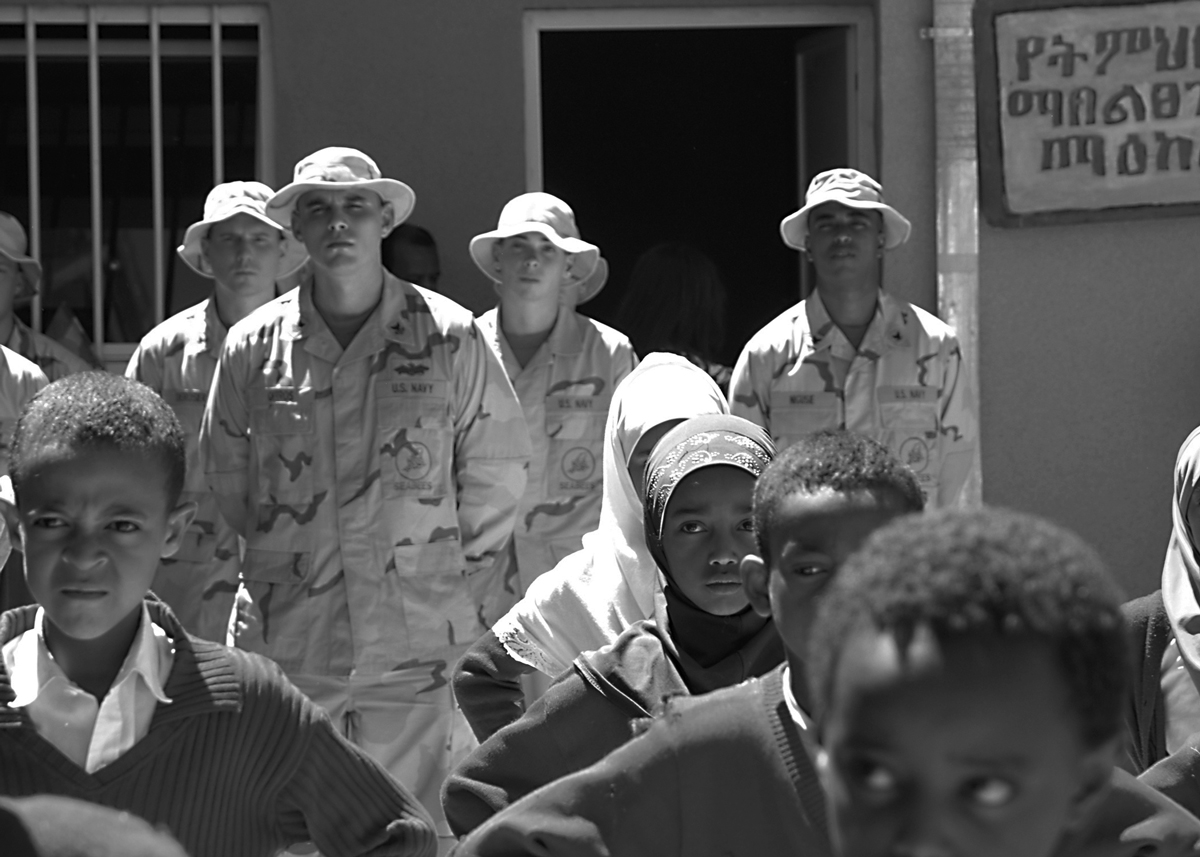
Following the season of heavy rains, October is springtime in the Horn of Africa, erupting in colors so riotous—a powdery blue sky, gleaming yellow daffodils and foliage greener than reality—that the landscape seems a kind of earthen womb, birthing a renewed and resplendent land, south of Eden, though far from grace.
The warming sun had begun to burn off the morning dew in Addis Ababa as I was wrapping up my first period class at the American International School of Ethiopia late last year. My 12th grade English class also seemed pregnant with possibilities, resembling the first buds of a bumper harvest, or better yet, a jazz orchestra rehearsing for a gig. It was six weeks into the first semester at AISE, the newest in a chain of private Ethiopian schools founded by a white educator from Minnesota, Dr. Leea Gibson, and her husband, a wealthy Somali businessman. Mapping out a mock trial the night before, I arrived at school the next morning giddy to describe the case I wanted adjudicated and assigning a shy girl we’ll call Ayana to play the role of the defendant. Her English was quite good, but like the rest of the class, she needed more reps producing meaningful language and I thought that playing the part of a young woman accused of murdering her wealthy, elderly husband would afford her an opportunity to elocute.
After we’d agreed on everyone’s courtroom role, I asked Ayana what she had to say for herself. With all the panache of Claire Trevor in a 1940s film noir, she replied unhesitatingly:
“I was set up.”
The entire class burst out laughing. Only a few weeks earlier, I’d shown my charges a 1947 movie, “Born to Kill,” that starred Claire Trevor, the queen of film noir; the students devoured the film and reviewed it with relish.
I had big plans for my kids at AISE, a K-12 college preparatory school for Ethiopian students who hoped to attend university in the U.S. It took no time at all for me to discover that most of my students’ comprehension of the language ranged from good to superb, but if they were to compete against mostly affluent white kids on enemy turf, they would have to learn to speak and write with confidence, to use English to fend off those who would do them harm and create their authentic African selves for the world to negotiate with.
In my mind, that meant engaging my Ethiopian students much as my African American teacher, Ms. McDowell, had done for me in my 5th grade Social Studies class 50 years earlier when she instructed me and three of my classmates at Indianapolis Public School 106 to imagine and reenact a scene from the Negro Baseball Leagues. (If memory serves, I was Josh Gibson, my best friend, Kelvin Bradford, was Cool Papa Bell and Ms. McDowell’s son, Ed, was Satchel Paige.)
Whenever I channeled my inner Ms. McDowell and raised the bar at AISE, my students not only met–but surpassed– my expectations. After we watched videos of Ted Kennedy eulogizing his brother Robert, and Ossie Davis eulogizing Malcolm X, then reading the obituary I wrote for my father, I instructed the class to write my obituary, pretending that I had slipped on a bar of soap in the shower and met my demise. I promised extra credit to anyone who managed to include in their prose that I was “dangerously handsome.” What they submitted was utterly entertaining—with a few rising to the level of dark comedy—and one girl’s appreciation of my time on earth so cheekily affectionate that it suggested an African iteration of Garrison Keillor’s A Prairie Home Companion.
In addition, the class was planning to author a travel guide of Addis Ababa, and to collaborate with foreign consulates representing English-speaking countries to provide tours to their citizens who traveled to Ethiopia. We were also in the initial stages of arranging for the seniors to regularly read children’s books to the lower grades at the school, and organizing a semi-formal storytelling event—modeled on San Francisco’s The Moth– in which they read to their parents, siblings and community culturally significant works such as the Palestinian poet Refaat Alareer’s final poem, “If I Must Die;” Ethiopian Emperor Haille Selassie’s eloquent 1936 address to the League of Nations appealing for international assistance to turn back Italian invaders; Nelson Mandela’s defiant 1964 speech at his sentencing for treason in apartheid South Africa; and the Democratic Republic of Congo’s Prime Minister Patrice Lumumba’s final letter to his wife before he was assassinated by Congolese soldiers under the command of Belgian intelligence officers.
And then there was the piece de resistance: halfway through the semester, the station manager at the Pacifica network’s Washington D.C. affiliate, WPFW 89.3 emailed to propose that I resume my weekly radio show that I had abandoned to move to Ethiopia. I accepted immediately, but with one caveat: I wanted my students to regularly produce content for my show.
The station manager excitedly agreed and I told my students in my senior English, Journalism and sophomore U.S. History courses, all of whom were over the moon at the idea of telling their stories, especially in the nation’s capital that was home to more Ethiopians than any city in the U.S.
Bubble Tests Versus ‘Eyes on the Prize’
But if my relationship with my students approximated a house afire, my relationship with AISE’s African administrators was that of oil and water. In discussing the teaching vacancy at AISE, I had specifically asked Dr. Gibson if I would be free to innovate and develop my own curriculum focused on storytelling. She assured me that I would but once in Ethiopia it was almost immediately clear that her affirmation represented a bait and switch, and that I had heard what I wanted to hear, so enthused was I at the prospect of teaching in Africa.
For starters, school administrators were obsessed with classroom discipline, prohibiting, as one example, the all-Black student body from wearing afros. Even more disturbing was the administration’s replication of the top-down school reform movement in the U.S. that began with the George W. Bush White House and escalated sharply under Obama. Specifically, AISE’s curriculum is modeled on the Obama administration’s Common Core State Standards that have been widely discredited after scholars repudiated the initiative as ineffective and African American and Latino parents complained that the “dumbed-down” classes were intended to short-circuit their kids’ critical faculties, reducing them to pliant, unorganized low-wage workers who never demand a pay raise, or a day off.
In that vein, the paperwork required of AISE teachers was so cumbersome that several in the lower grades acknowledged instructing students to simply put their heads down during class to allow them to catch up. Likewise, the school’s Ethiopian principal, Hadush Kiros, required teachers to not only provide students with lectures, but to then spoon-feed to them the notes on the lecture which they were to scribble down in their notebooks.
“I ain’t doing that stupid shit,” I said bluntly to Mr. Hadush as he was known at the school. When he asked why, I explained to him that it was antithetical to learning — “you develop critical thinking skills by taking notes, and choosing what’s important and what’s not,” I told him–and that AISE students will be required to compete against students from the best U.S. high schools who aren’t subjected to such goofy ideas.
Similarly, Mr. Hadush, his campus dean, Abele Ibrahim, a Kenyan, and another Ethiopian administrator, Akilu Belay, preferred standardized bubble tests measuring students’ memorization of dates (“What year did the Great Depression begin?”) and rules of grammar, rather than essays that better reflect students’ understanding of the material, and ability to articulate it.
Bubble tests had no place in my classroom. Like Ms. McDowell a half century ago, I tried to stir my students’ blood and seduce them into falling in love with learning. To that end, I began playing the documentary, Eyes on the Prize, to the sophomores in my U.S. History class and tasked them with identifying the similarities between African liberation movements and African Americans’ civil rights movement.
From the moment that the narrator, Julian Bond, introduced Emmett Till a few minutes into the first episode, the entire class was enthralled.
Messrs. Hadush, Ibrahim and Akilu, however, were nonplussed, and wanted me to teach a nearly 1,000-page-textbook financed by such reactionaries as Charles Koch, Mark Zuckerberg and Jeffrey Epstein’s BFF, Bill Gates. Written entirely by white, male historians including one former intelligence officer, their preferred textbook was uninteresting and unreadable, emphasizing, as one example, Islam’s role in the slave trade, and de-emphasizing, as another, African Americans’ pivotal role in helping the United States dig itself out of the Great Depression. On the whole, the Orientalist textbook evinced the Brazilian Marxist Paolo Freire’s theory that education is weaponized by the capitalist class to de-radicalize workers and reproduce inequality. Simultaneously, the textbook bore all the hallmarks of the Common Core movement that was intended to discourage intellectual inquiry and teach students of color what to think rather than how to think. Again, I flatly refused to teach the deeply flawed text in my classroom and instead proposed to teach Howard Zinn’s classic, A People’s History of the United States, once I was done screening Eyes on the Prize.
The Classroom as a Laboratory for Cultural Genocide
But I would never make it that far. No sooner had Ayana declared on that gorgeous October morning in 2025 that the criminal indictment against her was a frame-up than the campus dean, Mr. Ibrahim, burst through the door with another administrator and a female Muslim teacher. The students, most of whom had attended other Gibson schools, shot out of their seats to assume the position, hands in the air or against the wall, feet spread slightly apart, as they were patted down for contraband, namely cell phones. Finding none, Mr. Ibrahim apologized to me, and the three left in silence like a SWAT team after a futile search for illegal weapons or drugs.
My jaw must’ve hit the floor because one student, a tall, handsome, charismatic kid that we’ll call Dawit said with a smile:
“You’ll have to save us, Mr. Jon.”
At that moment, an awful clarity cleaved my soul in two just as the school bell rang signaling the end of class. Following orders from the stereotypical “nice white lady” sitting at home in Minnesota 7,700 miles away, AISE’s quisling administrators were intent on creating a correctional facility for gifted, middle-class Ethiopian kids, redolent of the zero tolerance policies and school resource officers that combined to both terrorize and criminalize schoolchildren of color across the U.S.
Leea Gibson had, in fact, exported the school-to-prison pipeline to the only country on the African continent that Europeans had not colonized. None of my kids at AISE were likely to end up in jail, but banning natural hairstyles, teaching from stupefying Eurocentric books, relying on unimaginative standardized tests, and stopping and frisking students were all part of a deliberate effort by Gibson to destroy the students’ confidence, turn them off from learning, discipline the most banal indiscretions, and transform AISE into a site of suffering every bit as much as public schools in Philadelphia, New Orleans or Oakland, particularly in the privatization era that began in Bill Clinton’s second term in the White House.
The American International School of Ethiopia represents a form of cultural genocide, reminiscent of Canada’s state boarding schools for the indigenous that sought “to kill the Indian to save the child.” Similarly, Dr. Gibson wanted to kill the African by forcing Ethiopian children to assimilate, to accept the European settlers’ norms as superior and their own as degenerate, to delegitimize African grievances against settler colonialism and to ultimately create a new generation of Manchurian candidates– like mini-Barack Obamas– who could be turned against other people of African descent both on the continent and across the diaspora.
The proof is in the pudding: the school reform campaign upon which Dr. Gibson modeled AISE’s curriculum was ostensibly intended to narrow the racial achievement gap in U.S. schools but has instead widened it.
In one telling text exchange that evinced her white savior complex, Dr. Gibson wrote to me:
“It seems you are trying to start a revolution for African power or human rights-but you are fighting against real Africans who are born and raised in Africa who are (b)orn and raised in Africa who are working hard for their children. It doesn’t make sense.”
The Schoolhouse as a Cash Cow
But it wasn’t just her settler ego that had convinced Dr. Gibson that she knew what was best for Africans and had been deputized to speak for them. Similar to Canada’s state boarding schools for the indigenous, AISE was part of the European settlers’ larger scheme to effectively lobotomize the very people they were robbing blind, the better to cover their crimes and misdemeanors. At base, Dr. Gibson, her husband and AISE’s administration aren’t nearly as interested in educating African schoolchildren as they are the cold hard cash that they pocket from charging annual tuition of roughly $4,365 for grades 7 through 12, and roughly $3,670 for grades kindergarten to 5th. With more than 500 students, they’ve raked in millions in revenues in AISE’s inaugural year alone, in part by claiming to have international accreditation; they did not.
And administrators were not subtle about their myopia. About a week after moving 12 foreign ESL (English as a Second Language) teachers —all of us Black—from a hotel to a guest house, the kitchen ceiling collapsed, nearly killing a Ghanaian teacher. They had not inspected the guest house as corroborated by the black mold in my room that sickened me and left me unable to work for nearly two weeks and conspired with the job stress to drive my blood pressure to resemble the score of a double overtime game in the old American Basketball Association. Moreover, while the ESL teachers complained about it incessantly, the water at the guest house was seldom hot and the electricity would flicker on and off as many as two dozen times in a single evening, leaving the teachers unable to work, cook or simply unwind in front of a television. Mr. Hadush had promised to buy a generator but never did, attributing the outages to the city’s antiquated electrical grid, unaware, apparently, that the teachers could peer out their windows during blackouts at the compound to typically see the surrounding neighborhood lit up like a Christmas tree.
Administrators routinely violated Ethiopian labor laws, requiring teachers to work nine-hour days and occasionally as many as 12 —in addition to federal holidays and weekends — without additional compensation and demanding that teachers obtain permission to leave the campus for lunch or at the end of the day.
The Ethiopian teachers had it far worse, earning less than a third of my salary as an American and less than half of what the other ESL teachers earned. What’s more, Mr. Hadush brazenly stole from the local teachers, deducting as much as a quarter of their salary, putatively for reasons as trivial as leaving campus for 20 minutes to pay an overdue utility bill between classes, and other sanctions not explicitly mentioned in the employment contract. Similarly, Mr. Akilu refused to return foreign teachers’ passports, fearing that they would not return because of their mistreatment, causing a Kenyan teacher to illegally cross Ethiopia’s border with Kenya to spend time with his family for the Christmas holidays.
It’s impossible to fathom AISE’s depravity without understanding that Messrs. Hadush, Akilu and Ibrahim not only lacked integrity but their fetishization of “whiteness” enabled the miseducation of Ethiopian schoolchildren, mirroring, at least partly, the two African American inmates, Solomon Poe and Roosevelt Knox, who were ordered by white sheriff’s deputies to beat Fannie Lou Hamer nearly to death in the summer of 1963 after she’d been jailed in Winona, Mississippi for attempting to register African Americans to vote. Hamer pleaded with the men: “You mean you would do this to your own race?”
They most certainly would, leaving Hamer with injuries and scars for the remainder of her life. The only difference between Hamer’s torturers and Messrs. Hadush, Ibrahim and Akilu is that while the former were coerced, the latter would brutalize their own for a fish sandwich, similar to the Boondocks’ cartoon character, Uncle Ruckus.
Black Mold, White Ice
Mr. Hadush hired only three whites at the school, all as directors to ensure, ironically, that AISE’s curriculum was consistent with U.S. educational standards. One of the white administrators quit only weeks into the first semester, frustrated both with the school’s lack of academic rigor and its racial politics. Another white director stayed and was quite popular with the African teachers and students. But the third, an elderly white man from Pennsylvania, Garry Bohm, was widely loathed by teachers and at least the older high school students who resented his shrieking, Donald Trump-styled racism. He once scolded the teachers in the faculty lounge who he thought were too slow to volunteer to cover for an absent colleague; belittled teachers in front of their students in classroom evaluations and once assembled the African teachers for a meeting in an aborted effort to “train” them to lose their lyrical African accents.
Because of his self-loathing, Mr. Hadush and I got off to an inauspicious start on the first day of class when he took me to task for looking at my phone during the students’ lineup before class. He had only sent out the classroom assignments two hours before the start of the school day and none of the ESL teachers had any idea where to go. As we filed out of the gymnasium headed for class, Mr. Hadush lit into me: “Jon, what are you doing on your phone while I am talking during lineup? You’re supposed to be setting an example for the students!”
I nearly throttled him but instead replied coldly only inches from his face:
“Who you talking to, son? Any idiot should be able to see that if I have my phone out on the first day of class I am trying to figure out where to go since you just sent out the schedule two hours ago!”
I left him looking flummoxed as I rushed off to my homeroom class but returned to his office during a break wanting all the smoke.
“I didn’t appreciate that stunt you pulled earlier today. I think I am owed an apology.”
He did, I accepted and walked off, thinking the matter settled. Not 10 minutes had passed when he sent Garry to have a word with me, reprimanding me again for looking at my phone during lineup. I would go on to call Garry everything but a child of God and ultimately told him not to speak to me again, with which he mostly complied.
That was the high-water mark in my relationship with school administrators and for the rest of my time at the school the tension between me and Mr. Hadush was analogous to that between Samuel L. Jackson’s character, Stephen, and Jamie Foxx’s eponymous character in Django, Unchained.
About a month into the school year, I reached an agreement with AISE’s President, Zackaria Mohammed Aden, who was Dr. Gibson’s son. Zack, as he was known, had attended university in the U.S. and acknowledged that he initially struggled to keep up with the coursework after attending Gibson schools. In a Friday afternoon meeting with Mr. Ibrahim, Zack exempted me from the school’s onerous paperwork demands and the practice of feeding class notes to my students, agreeing instead that I could merely instruct students to take notes while creating a project-based curriculum. The following Monday, Mr. Hadush called me into a meeting attended by Mr. Ibrahim, Garry Bohm and the campus dean for the lower grades, a Burundian name Mike Runoku, the purpose of which was to demand that I begin to provide my students with notes of my lectures.
“I’m sorry,” I said, “perhaps you need to check with the school president who just 72 hours ago told me to work with Mr. Ibrahim on developing a more project-oriented approach for my classes.”
“Yes, Zack is the president but I’m the principal,” Mr. Hadush said.
“Exactly,” I said.
At that moment, Zack walked into the 4th floor classroom. Mr. Hadush tried to shoo him away but I gestured for him to come in:
“Zack, your ears must’ve been burning. We were just talking about you! Would you please explain to these distinguished gentlemen your instructions to me on Friday.”
Zack tore into Mr. Hadush especially, reprimanding him for challenging his decision, and praising my teaching methodology which he had observed. Before I could devise a syllabus that reflected my classroom approach, however, I fell seriously ill as a result of the black mold in my room at the guest house. When I texted Mr. Hadush to report my absence and inform him that I suspected that black mold was the source of my illness, he did nothing. When an emergency room doctor confirmed my suspicion both in writing and in a face-to-face conversation with Mr. Ibrahim who came to pay the bill, he did nothing. In total, I missed nine days of classes before administrators addressed the environmental toxin that was in my room; once they did, my recovery was immediate.
While I was out, however, Mr. Hadush reassigned my U.S. history course first to an Ethiopian biology teacher and then to a teacher from Swaziland who had never stepped foot on American soil; she had neither the qualifications nor any interest in teaching the course. Compounding matters, AISE administrators instructed her to use the Common Core U.S. history book that I refused to teach.
Still quite ill, I tried to return to work to confront Hadush about reassigning my classes and using a book that did more harm than good, as well as his inaction in removing environmental hazards at the guest house. In his office with Mr. Ibrahim and another administrator, I demanded to know:
“Why haven’t you addressed the black mold in my room?”
He answered, preposterously, that none of the other teachers were ill. Moreover, he said that my absences were unexcused, despite the fact that an emergency room doctor had given Mr. Ibrahim a written note attributing my illness to black mold in the guest house and had even explained it to him in a face-to-face conversation. (I later learned that Mr. Hadush had even posted on the bulletin board in the teachers’ lounge a sheet recording all of my absences as unexcused.)
As for my classes, he said that they had been reassigned because I had failed to comply with his paperwork and note-taking policies.
At that point, I leapt from my seat, leaned over his desk and exploded.
“Dude, what is wrong with you? Are you deaf or just stupid? Zack just told you twice that I am exempted from that bullshit!”
We continued to go back and forth until finally I stormed off. Two days later, Messrs. Akilu, Ibrahim and another administrator called to meet with me. At a patio café, they assured me that they would address the black mold but they wanted me to apologize to Mr. Hadush. I agreed, if my classes were returned to me and I could have my students work on my radio program. It was a volunteer position, I told them, so there was no question of financial exploitation, and public radio in the U.S. is highly regulated so there would be no inappropriate content. Moreover, I said, appealing to their greed, Washington D.C. was home to the country’s largest Ethiopian population, and it was relatively affluent; the radio show would be a huge boost to their fundraising efforts.
I shook hands with Mr. Akilu thinking we had a deal and returned to class 36 hours after they boarded up holes along the baseboard in my room from which the black mold emanated. But of course, they had no intention of honoring their end of the bargain.
Sabotaging the Competition
Education has always been the holy grail of Black liberation. Of emancipated slaves, I wrote in my book, Class War in America: How the Elites Divide the Nation by Asking ‘Are You a Worker or Are You White?’:
“Such was their enthusiasm for “book learnin” that one administrator for the Freedmen’s Bureau—the federal agency responsible for managing the Reconstruction effort—compared it to a type of derangement, so ‘crazed’ were they to learn. A newly liberated father in Mississippi proclaimed, ‘If I nebber does nothing more while I live, I shall give my children a chance to go to school, for I considers education [the] next best ting to liberty.’”
The quality of African American schoolchildren’s education was at the heart of the U.S. Supreme Court’s 1954 decision in Brown versus the Board of Education, as it would be 14 years later when Black and Puerto Rican parents took over their children’s Brooklyn schools and eight years later when South African police mowed down as many as 700 Black students protesting apartheid education in the all-Black Johannesburg township of Soweto. Nearly 600 colleges and universities in the U.S. launched Black Studies programs within five years of Malcolm X’s assassination, and a number of African liberation icons, including Mandela, Ghana’s Kwame Nkrumah, Tanzania’s Julius Nyere and Zimbabwe’s Robert Mugabe were educated at Christian missionary schools that delivered education that was antithetical to the Common Core or AISE’s robotic approach. It has for decades been clear to African Americans that Africans freed of the white gaze are generally smarter than diasporic Blacks educated by white mediocrities like Dr. Gibson. A friend of mine attending medical school 30 years ago would sometimes joke that a test was so difficult, “you had to be African to pass it.”
Blacks, both on the African continent and in the diaspora, have always understood education as a prophylactic to insulate their children from settler colonialism’s most barbaric tendencies. But since the collapse of the Berlin Wall, Western elites have turned that notion on its head as investors have sought to replace profits lost when they began to ship smokestack industries abroad to Mexico, Central and South America, south Asia and China in an attempt to lower their employees’ wages. The ensuing effort to leech off existing services —known by economists as “rent-seeking”—has animated Western economies in the 21st century and culminated in the emergence of commercial enterprises such as Uber and Airbnb, and the privatization of public utilities, prisons and schools.
And Ethiopia has an additional cross to bear: between 1974 and 1991, a military dictatorship known as the Derg assassinated the country’s Emperor, Selasie, and killed more than 150,000 dissidents, targeting university students and academics especially. Many Ethiopians of a certain age today believe that the purge of an entire generation of intellectuals, followed 17 years later with the introduction of Western-styled capitalism that promotes tribal divisions, has saddled the professional class with halfwits like Messrs. Hadush and Akilu, who ascribe to the white identity a kind of mystical, God-like status.
And yet if capitalism is, on its most molecular level a Ponzi scheme that dispossesses workers, racial capitalism hones in on an African-descended proletariat with the intensity of a laser beam, inseminating an educational system that no longer seeds financial mobility but atomizes it.
African American teachers such as Ms. McDowell have traditionally shielded their Black students from white educators who wanted nothing more than to sabotage their children’s competition, while Black educators like Mr. Hadush are part of a growing, global Black Misleadership class—to appropriate a term popularized by Black Agenda Report’s late Executive Editor Glen Ford—that stretches from Atlanta to Addis Ababa and exists solely to spit-shine the reputations of white miscreants like Dr. Gibson and Garry Bohm who inflict irreparable harm on our youth.
Consider that I reported everything I wrote here in a memo dated December 9th of last year to Ethiopia’s Education Minister, Berhanu Nega, who did absolutely nothing. Make of that what you will.
My tenure at AISE would end roughly six weeks after the mid-October English class preparing for a mock trial, with Messrs. Hadush and Akilu claiming absenteeism that of course they were wholly responsible for. They refused to pay for either my last three weeks of work, or the three months’ severance I was owed in accordance with Ethiopian law though they insisted on buying my plane ticket to leave the country, wanting, I imagine, to be rid of me. In a final, contentious meeting with Zack, and Messrs. Hadush, Ibrahim and Akilu, Mr. Akilu said to me at one point, referring to the $900 plane ticket the school had purchased and roughly $125 in medical bills that I incurred:
“Jon, do you know how much money we’ve spent on you?”
My life flashed before my eyes in that moment: I recalled Ms. McDowell’s lovely face though I hadn’t laid eyes on her in probably 45 years; I thought of Ayana’s jarring potential, the obituaries my class had written to mark my passing, Dawit half-jokingly pleading with me to rescue the class, and the African genius that has been squandered, snuffed out and shat upon for the better part of 400 years by a European settler culture that values neither art nor truth nor even humanity, but only graft and theft and the power to redefine themselves and the world in a way that obscures their crimes against humanity.
And what surfaced from my mouth all at once was motivated by the deepest love and most murderous rage that I have ever felt concomitantly, resulting in what I believe might be the truest words that I have ever uttered:
“Motherfucker, I don’t give a grimy shit how much money you spent. I ain’t no fucking accountant. I am a teacher, the great grandson of a slave who was named for an uncle who was lynched. I will kill all three of you Uncle Toms before I help you miseducate African children!”
THE TIMELINE
How we got Here:
⇑
2013
2013: Chicago Mayor Rahm Emanuel closes 50 public schools in a single year, the most ever at one time in the U.S. Nearly 90 percent of the closures are of schools that serve majority Black or Latino enrollments.
⇑
2000
2000: Dr. Leea Gibson opens the Gibson Youth Academy in Addis Ababa with her husband, Mohammed Aden
⇑
1976
June 16, 1976: Students in Johannesburg’s all-Black township, Soweto, lead a massive protest against the apartheid government’s mandate to use Afrikaans, derived from the Dutch language, as the medium of instruction in schools. Police fatally shoot hundreds of children.
⇑
1969
March 20, 1969: Administration at San Francisco State University agrees to students’ demands to create the first Black Studies Program in the U.S.