
How Black Lives Matter Plaza in DC Came to Symbolize the Movement’s Tombstone
From Atlanta’s Vine City to D.C.’s Chocolate City, Paying Homage to SNCC’s Black Power Blueprint
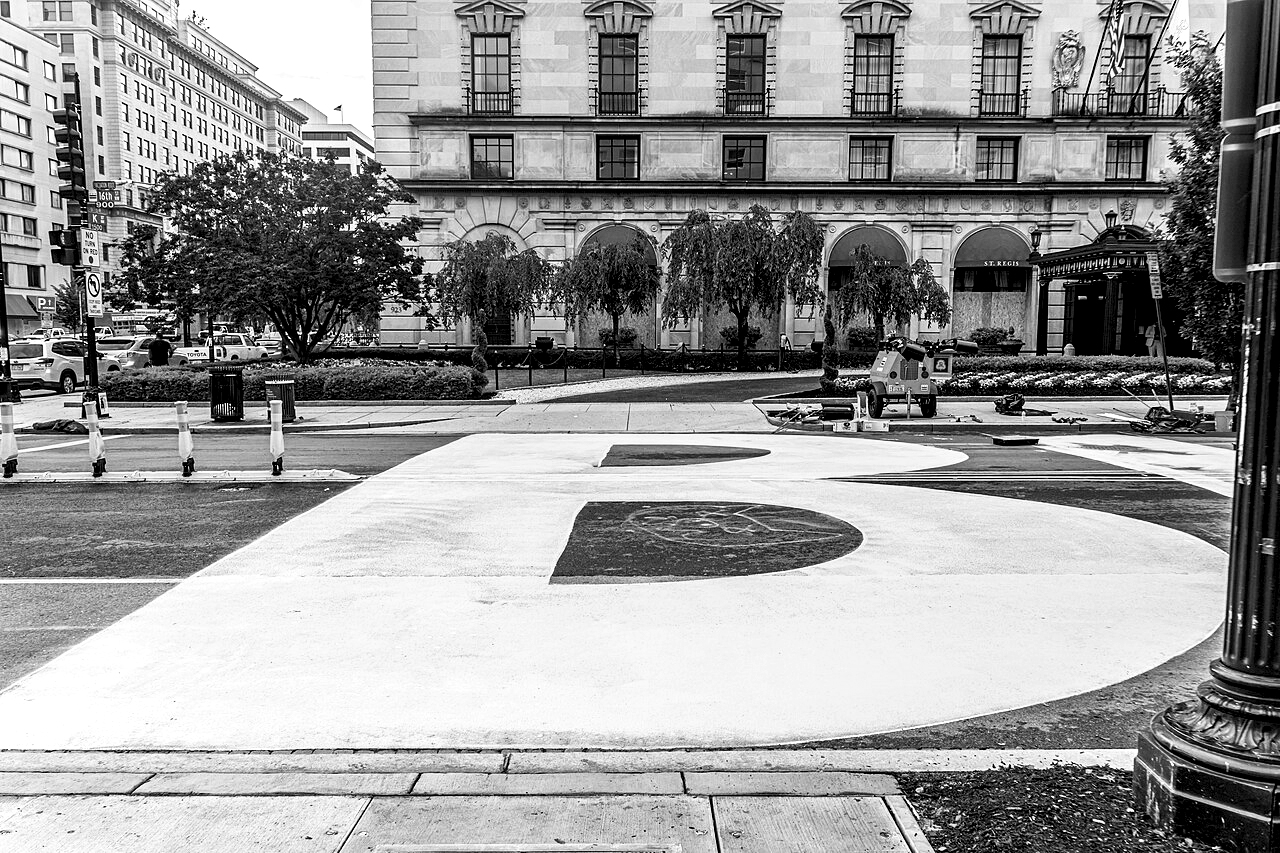
After the jackhammers finally fell silent and the pickaxes were put away, after the work crews dismantled the bollards, erased the big, bumblebee-yellow letters and repaved the two city blocks within the White House’s direct line of sight, Black Lives Matter Plaza was gone.
When it was erected five years ago in 2020 during the season of upheaval that followed the murder of George Floyd by a Minneapolis patrolman, the Washington D.C. press corps mostly described the mural as a symbolic middle finger extended by the District’s African American Mayor, Muriel Bowser, a Democrat, to President Trump who had publicly quarreled with her and antagonized protesters.
But if the mural’s unveiling is portrayed as an act of defiance, Bowser’s decision in February to remove it can only be understood as acquiescence to the notoriously petty Trump, who returned to the White House seeking to settle old scores by ordering his Republican vassals on Capitol Hill to issue the city an ultimatum: take down the plaza or lose hundreds of millions in federal funding.
While there is a germ of truth in this narrative, it is so lacking in context that it misses the point almost entirely. First elected in 2014, Bowser exemplifies a generation of African American mayors across the country who represent the economic interests of a gentrifying, white elite and a smattering of bourgeois Blacks who want in on the deal. Far from being a reliable ally to the city’s African American working class, Bowser’s policies, almost without exception, redistribute wealth upward, from employees to their employers, tenants to their landlords and borrowers to their creditors.
The activists who poured into the streets in the summer of 2020 following Floyd’s murder wanted a commitment to shrink the Metropolitan Police Department as a means of lessening state violence against African Americans and Latinos who are disproportionately in the line of fire. What they got instead from Bowser was a “temporary tattoo,” and an increase in the police budget every year since.
The irony is that for D.C.’s Black Lives Matter activists and their comrades, Bowser’s creation of the colorful but ultimately meaningless streetscape is widely considered a cynical and jejune ploy to placate—if not frustrate—their specific, material demands for racial justice. By their lights, when Bowser gave the order to erect the plaza, she was not extending her middle finger to Trump, but to them.
That perspective is borne out by their initial response to the mural. Just a day after its completion on June 5, 2020, a dozen or so activists hauled buckets of paint to 16th street, converted the D.C. flag into an “equals” sign and added a phrase so that it momentarily read: “Black Lives Matter = Defund the Police.”
According to the Washington Post, one organizer shouted:
“This is ours. This is all ours. This city is ours. These streets? Ours.”
That same day, Black Lives Matter D.C. tweeted of the plaza:
“This is a performative distraction from real policy changes. Bowser has consistently been on the wrong side of BLMDC history. This is to appease white liberals while ignoring our demands. Black Lives Matter means defund the police.”
Rose Jaffe, one of the local artists commissioned to paint the street mural, expressed ambivalence about the project, telling the Washington Post:
“I’m conflicted about doing it. It’s about wanting to reclaim the streets, but I also know that it is a little bit of a photo op. Where is the action behind this?”
It seems only fitting that a transformative Black Power movement would meet its end here in this stronghold of African American political militancy once known as “Chocolate City.” The truth of the matter, however, is that the radical Black body politic has been a spent force for at least a generation; that it can no longer shape policies on the ground nor even sustain a purely symbolic gesture as impotent as Black Lives Matter Plaza speaks not to its death but to its decomposition, redolent of a rotting corpse found in a shallow grave.
An autopsy unearths a movement’s short life and brutal death.
Not just a call to arms, Black Power was as transcendent as any social movement of the 20th century. First articulated by Malcolm X’s politics of self-reliance, Black Power is the understanding that integration is insufficient—if not altogether disadvantageous– to liberate African Americans from exploitation by a settler colonial Republic. What we need, critically, is self-determination: the ability to assert democratic control over our communities and its institutions—City Hall, the schools, the police, courts, banks, and businesses —just as whites exert authority over theirs.
The concept spread like wildfire after Malcolm’s assassination in 1965 and the passage of the Voting Rights Act months later but nowhere did the idea of Black sovereignty catch on more than here in the nation’s capital, which is ironic since Congress does not recognize the District as an autonomous state.
Still, beginning in the mid-60s, activists with the Student Non-Violent Coordinating Committee, or SNCC, flocked to the District, which is home to Howard University and a population that, at the time, was roughly two-thirds African American. Among them was SNCC’s first chairman, Marion Barry, who would go on to be elected to the school board and later as mayor in 1979.
Barry’s administration provided summer jobs to tens of thousands of teenagers, home-buying assistance for working-class residents, and food for senior citizens. To fill thousands of middle- and upper-level management positions at City Hall that had previously been reserved for whites, he hired African Americans and increased seven- fold the number of municipal government contracts doled out to minority vendors, the vast majority of them Black. In 1986, the District awarded 39 percent of its business, $185 million, to minority-owned firms, more than any other city in the country, and worth more than half a billion in today’s dollars.
Housing was a focal point of the Barry administration. Sunni Khalid, who would go on to work as a foreign correspondent for National Public Radio and as a Baltimore Sun reporter, recalled Barry campaigning for mayor at Howard University in 1979, Khalid’s freshman year, and urging students to help him revitalize the city by buying a home. After he was elected, Barry initiated a joint program between the city government and the private sector to rehabilitate 733 of the estimated 4,500 vacant, boarded-up housing units in the city. The program included rental housing, public housing, condominiums, cooperatives, and 200 new single-family homes, and even helped lower-income families borrow up to $11,000 for a down payment on a home.
Housing was also the centerpiece of a forgotten project undertaken by Barry’s colleagues in SNCC.
In 1965, the year that Barry moved from Tennessee to D.C., SNCC spokesman Julian Bond won election to the Georgia Legislature, representing an Atlanta district. Georgia lawmakers refused to seat him, however, alleging that Bond’s signature on a SNCC statement denouncing the Vietnam War was disqualifying. Simultaneously, SNCC’s leadership was looking to regroup following the Democrats’ refusal to seat Fannie Lou Hamer’s Mississippi Freedom Democratic Party at the 1964 national convention in Atlantic City. Omali Yeshitela, the chair of the African Socialist People’s Party and a former SNCC member told Black Republic Media:
“There was a sort of trajectory at the time to move away from the Democratic party. We assumed that we would not become full-fledged members of the Democratic party so we were no longer holding up the Democratic Party’s values…Our only objective was to win power… for Black people.”
The organization decided to support Bond’s reelection, but they would also use the opportunity to pivot from rural organizing to urban areas like Atlanta. Led by a dynamic group of young African American activists that included Bill Ware, Gwen Robinson and Michael Simmons, (who would later marry) the Special Committee to Reelect Julian Bond began canvassing Atlanta neighborhoods in January of 1966, with a particular focus on the hardscrabble neighborhood known as Vine City.
Standing in the shadow of the Georgia Capitol’s gold-leafed dome only a mile and a half away, Vine City was as poor as America gets. After touring the neighborhood in 1965, Martin Luther King Jr. said that the “living conditions were the worst I had ever seen…I had no idea people were living in Atlanta in such conditions. This is a shame on the community.”
In his wonderful book, Stayed on Freedom: The Long History of Black Power Through One Family’s Journey, Dan Berger wrote:
“The maxim of organizing still held true: meet people where they were at. And where they were, bright and early every weekday, was at Five Points. Segregation had kept Black from white when it came to housing but bonded through labor. Almost half of Atlanta’ s population in 1966 was Black, and the majority of them worked as laborers. Five Points was the transportation hub connecting Vine City to other parts of Atlanta. It resembled the area in the Bronx that SNCC advisor Ella Baker had, decades earlier, described as a ‘slave market.’ From Five Points, Black women would catch buses to the northeastern suburbs to get white children to school on time and tend house as domestics, while Black men headed downtown to the military induction center or low-level work.”
Michael Simmons told Black Republic Media:
“We would be at Five Points at 5:30 in the morning handing out leaflets and they weren’t one-page leaflets, they were four-page leaflets that told a story. We got so familiar with the workers that you know if we missed a day they would be looking for us.”
Continuing, Berger wrote:
“The most immediate concern was the blighted state of housing. Old shacks that often lacked plumbing and heat sat on cinder blocks to prevent flooding. One of the biggest slumlords was Joe Shaffer, who operated what the Atlanta Project described as a ‘plantation-like system in which he acts as landlord, employer, grocer, creditor, sheriff, judge and jury over the people who live on his property.’ Shaffer overcharged and underserved his tenants in violation of the city’s already weak housing laws. At the suggestion of SNCC attorney Howard Moore, the Atlanta Project began collecting affidavits from residents about the problems with their landlords. A thirteen-year-old who lived in an apartment without so much as an icebox reported that the ‘rats are almost bigger than my doll.’ In a two-room apartment occupied by eight people, a twenty-three-year-old man ‘had to kill a snake… The floor has holes and it is partly rotten,…‘I’ m afraid it will fall in.’ When Shaffer evicted several residents for failure to pay rent that January, the Atlanta Project — only weeks into existence but already with strong ties in the neighborhood — organized a protest. Gwen borrowed a truck from SNCC’ s headquarters to help one of the families move to another house while other project staff brought blankets to those without heat. Days later, the project held a rally against Shaffer, demanding, ‘Slumlords must go!’ This maelstrom helped catalyze a rent strike among the residents. All winter, the project kept pushing. With a paneled van and a loudspeaker, project staff drove through the neighborhood blaring The Impressions (‘You’ ve been cheating,’ dedicated to Shaffer) and Bobby Bland (‘Too far gone to turn around,’ dedicated to the tenants) while residents placed furniture in the street.
Short of money, the Atlanta activists substituted grit and guile, relying on innovation to solve problems, and creating a blueprint for radical groups such as the Black Panthers which was born in Oakland 9 months later. Berger again:
“With the streets blocked, Atlanta Project members helped residents charge a toll to anyone who wanted to cross. The unauthorized tax collection garnered $180, including ten cents from a police officer, to help bail out tenants and SNCC activists who had been arrested in the protest. All the while, they coordinated a sophisticated get-out-the-vote operation — providing childcare for voting mothers, calling constituents, taking people to the polls, and knocking on doors, always knocking on doors. On February 23, Julian Bond was easily reelected to a seat he had yet to occupy.”
Winston Grady-Willis, Director of Black Studies at Skidmore College, told Black Republic Media that the Atlanta Project, as it came to be known, represented SNCC’s inevitable maturation.
“In Lowndes County, the Freedom Schools were confronted mainly with the Klan and the threat of domestic terrorism. When they wanted a break from dealing with the extraordinary pressures of that, they would go to Atlanta for a good time… one of the things that Ella Baker always stressed was this need for power to move from the grassroots upward for communities to be able to have control over resources and not just rely on a charismatic leader.”
The project also promoted a sense of Black consciousness. Early in February of 1966, as Atlanta police were arresting a cadre of SNCC activists for attempting to block an eviction, Bill Ware shouted out as he was being hauled away:
“There must be unity among Black people. The only way we can stop evictions is for the people to come together!”
By 1966, Marion Barry had quit SNCC to start a youth-centered non-profit organization in D.C., Pride, Inc. But all of the elements that characterized the Atlanta Project—the grassroots approach, innovation, Black nationalism, its focus on housing—characterized his leadership both as an activist and mayor. Yeshitela told Black Republic Media:
“A lot of other SNCC folks had gone with Barry to DC and there were some similarities between how he moved politically and how the Atlanta Project moved. I don’t think that was a coincidence.”
Barry’s friend and pastor, Rev. Willie Wilson of Union Temple Baptist in southeast D.C., told Black Republic Media that while he never heard Barry speak of the Atlanta Project, Black consciousness was at the core of his leadership.
“He so identified with the masses of downtrodden Blacks and that is why he was beloved by the people. You are talking about thousands of young people who got their first paycheck through his administration. To a lot of them those monies were used to maintain their family household. You know, we’d be walking down the street and he would meet someone and he’d say ‘you got a job?’ Here, go downtown and say that I sent you.’ Barry instilled a pride in this city that… you could look at his government and look at all these qualified Black men and women who ran this city and that was something that the people in power couldn’t fathom
It was a model for the nation.”
Kwame Ture (née Stokely Carmichael) would famously coin the slogan “Black Power” at a speech in Greenwood, Mississippi in June 0f 1966, a little more than four months after Bond’s reelection. Ware, Robinson, Simmons and other organizers with the Atlanta Project would go on to author an influential white paper on Vine City which, among other things, exhorted SNCC to purge white members, partly as an acknowledgement of white liberalism’s limitations but also as an understanding that whites could best serve the Black liberation movement by organizing other whites.
The Vine City white paper was deeply polarizing within SNCC, and Bill Clinton referenced the rift in 2020, incorrectly, eulogizing the organization’s former chairman, John Lewis, as a safer Negro than Ture. In fact, while the moderate Lewis was critical of the Vine City paper, so too was the more militant Ture.
Said Grady-Willis at Skidmore College:
“I think the Atlanta project activists were really ahead of their time.”
George Derek Musgrove, a professor of African American history at the University of Maryland at Baltimore County and co-author of Chocolate City: A History of Race and Democracy, pinpoints the end of the Black Power era in D.C. to 1998 when many of the city’s then aging activists gathered to pay tribute to a terminally ill Kwame Ture. That event was held just one month before Barry decided not to run for a fifth term; he’d been reelected to his fourth following his release from prison for his conviction on a single misdemeanor count of cocaine possession. Bowser is the city’s fourth mayor since Barry left office in 1999, all of them are Black and all of them supportive of gentrification policies that are, in effect, a rejection of Barry’s Black Power agenda.
Though they share the same initials, Barry’s first three terms in office couldn’t have been more different from Bowser’s first three. While the percentage of city contracts awarded to minority vendors remains relatively high in terms of total dollars– 37 percent–70 percent of that goes to just a handful of vendors. Said council member Kenyan R. McDuffie, who oversees the council’s business and economic development committee and led the effort to fund the study:
“The numbers are extraordinarily low, even if the total dollar amount exceeds that of other places.”
Similarly, Bowser’s administration has continued to push home prices out of reach for African Americans. The percentage of Black households that own their own homes has plummeted from nearly half in 2000 to roughly a third in 2022. A recent study found that of all homes sold in D.C. between 2016 and 2020, first-time African American homebuyers could afford only 8.4 percent while first time white homebuyers could afford 71 percent of the homes on the market.
Moreover, if Barry’s administration inculcated in African Americans a sense of dignity, Bowser’s is defined by a growing sense of disillusionment, redolent of what SNCC encountered in Vine City when they arrived in 1966.
At the 2020 celebration to commemorate the impromptu revisions to the D.C. Black Lives Matter mural, onlookers began to dance to the Frankie Beverly and Maze classic, “Before I Let Go.” When the dancing stopped, Black Lives Matter members began calling Black people to stand on the mural.
“Come into the circle. Black people only.”
Eighteen-year-old Rohena Innocent was standing with her friend Dominique Frederick, 19, just behind the yellow caution tape as Black Lives Matter D.C. put the finishing touches on their pointed response. While Frederick referred to Bowser’s mural as a “temporary tattoo,” Innocent mused openly to the Washington Post:
“It’s great marketing.”
Then she added, speaking in unison with Frederick:
“But it’s not enough,”
Standing next to them was their friend, 21-year-old Sofia Martinez, who spoke wistfully of a D.C. that she was too young to remember, telling the Post:
“This used to be Chocolate City.”
Yeshitela said that Chocolate City was lost in 1989 when too many African Americans first saw the now iconic videotape of Barry smoking crack cocaine in a darkened D.C. hotel room and found it amusing. We should have recognized it for what it was: a coup.
“It was this decolonizing movement that thrust Barry into this position of leadership in Washington D.C., 70 percent Black surrounded by a sea of hostility. But he could withstand it as long as there was a deep and profound passion for freedom that permeated everything and we had organizers on the ground who were doing the work…But that was crushed, people were assassinated, put in jail. ..Marion himself didn’t have the revolutionary stamina. The people want to be free but we have no organization, we have no capacity as we did back…in the 60s when you saw an international movement, a global revolution was on the horizon. You don’t hear anybody talking about revolution today.
Back then we all presumed that the system is going to die soon. There is no such presumption today.
THE TIMELINE
How we got Here: